

When purchasing coins, especially those that are considered collectibles and rare, there is always the looming concern the coin might be a fake. Looking out for counterfeits can be a tough thing, as there are a few different types of gold and silver coins out there. Let’s take a look at some of the types of counterfeit coins you might run into along the way.
Cast Fake Coins
This is one of the cheapest and more common ways in which coins tend to be faked. Cast fake coins are produced by pouring a liquid metal mixture into an authentic coin’s casted mold. This authentic cast might have been taken or copied from a facility, or it may have been reproduced through other ingenious methods. Most counterfeit producers tend to prefer casting, as it provides a simplistic means to replicate coins with ease, to a point where the counterfeits can sometimes be indistinguishable.
Struck Counterfeit Coins
Struck counterfeit gold and silver coins undergo a more difficult process than cast fake coins, as the process through which they are created is similar to methods used by mint manufacturers. The counterfeit is created by placing a planchet—a flat, round metal disk—between two coin dies, which are then pressed together by a hydraulic press. The planchet is thus molded between the casts, creating a replicated coin.
Doctored Counterfeit Coins
This method adjusts a normal coin until it looks either rare or antique. A common coin will have slight engravings or etchings applied so it appears to be more valuable than it is, or it will be “split.” Splitting is a counterfeit style where two coins, one inexpensive and one seemingly rare, will be merged to create one “valuable” coin. With these different methods in mind, there are ways you, as a buyer, can spot a counterfeit. Here are some tried-and-true methods you can use to spot a counterfeit along the way.
Dimensions
Each coin produced by the U.S. Mint has specific dimensions that are utilized to verify the authenticity of a coin. These specifications include a coin’s metallic content, weight, diameter, and thickness, and its year of minting. For instance, a 2019 American Silver Eagle 1 oz. coin will have the following specification:
- Silver Content – 1 troy oz.
- Composition – .999 fine silver
- Diameter – 40.6mm
You can check some measurements of silver coins like this right at home. With an accurate scale, one that can preferably measure to one one-hundredth of a gram (0.01 gram), you can measure the weight of your coin to determine if it is 1 troy oz. (31.1035 grams). Next, you can use a fine measurement tool, such as a pair of calipers, to measure the diameter of said coin.

Visual
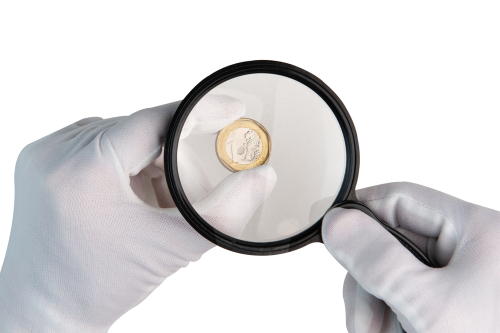
Grab a magnifying glass and take a closer look at your coin. You’ll be looking for small incongruities here, such as mismatching surface texture, text spacing, seams, markings, and edges. Compare whatever you see to an authentic coin, whether you have that in person or from a high-quality image online. If you notice any differences between the two of them, you might just have a counterfeit coin on your hands.
Magnetic or Not
Both silver and gold are non-magnetic metals. For this reason, neither a fine gold nor a silver coin should have any magnetic reactivity with a magnet. To perform a simple test, grab a magnet, preferably a stronger one, and place it near your precious metal coin. If the coin is attracted to the magnet, you know you have a fake on your hand, as magnetic metals such as iron and steel might have been used in the production of the counterfeit coin. Consider purchasing a neodymium magnet if you want to truly test your coins, as these high-magnetic-field-producing magnets can detect trace metals of iron, steel, and copper.


If you’ve tried any of these methods on the coins in your possession, we only hope that none of them appeared to be counterfeit. If it just so happens that you have a counterfeit gold or silver coin in your possession, it’s not the end of the world. It happens! All it means is that you should be a bit more wary when shopping for coins in the future.

