
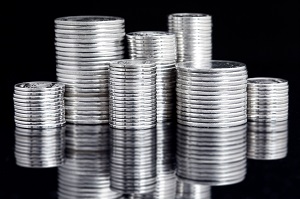
Silver is well-known as a form of fine jewelry and as an excellent investment, but it’s also highly desirable in industry. In fact, it’s the shifting in industrial demand that can cause the price of silver, as an ETF or as bullion, to be volatile.
But what is all that industrial silver good for, anyway?
A lot, it turns out–and odds are good that you have some with you now, without even knowing it.
Here’s a rough breakdown of the weird places you might encounter this investment metal.


Photography
One of the more widely known uses for silver is in traditional film photography. Demand for silver was much higher when everyone relied on film instead of digital, but silver use in photography is now down to high-quality prints. Silver, in the form of silver halide crystals in the film, is light sensitive, making silver the reason film photography can capture an image that can later be developed into a beautiful print for your home.

Passports
Newer U.S. passports now include chips to digitally store identity information. These “epassports” rely on radio frequency identification, or RFID. The RFID chip is a microprocessor and, you guessed it, contains silver.
And you may have one if you aren’t a U.S. citizen, too: similar epassports are used in 28 countries.
You may also find an RFID chip on products at the store, as they are sometimes used to monitor inventory in tandem with traditional barcodes.


Drinking Water
Okay, silver isn’t directly in your drinking water, but it is used to transport and purify it. Silver has natural antibacterial properties and is non-toxic to humans, so it is now sometimes used as a replacement for old lead-based bonds between water pipes. Additionally, silver is often included in carbon-based water filters to prevent bacterial growth, and water purification systems use silver ions to help oxidize the water and kill microbes. So drink up!


Solar & Nuclear Power
Silver has the best thermal and electrical conductivity of all metals, so it is welcome in energy industries. Silver’s fastest-growing consumers are now in the solar power arena, where it is used, in a paste form, in the photovoltaic cells of solar panels. It’s the silver that allows the solar panel to carry the electrical current generated by the sun’s rays. Silver is also used in solar panels to reflect sunlight into the collectors.
You can also find silver products in a nuclear power plant. If you want to slow down a nuclear reaction, you’re going to need a silver control rod to insert into the nuclear core. The silver captures neutrons and impedes the nuclear reaction; just remove the control rod to speed it back up again.


Clothing
Ever buy those fancy antimicrobial socks that promise to keep your feet from stinking? The anti-stink agent is none other than itty-bitty silver, included in the blend of fiber in the sole of the sock to bust up any rank foot-loving microbe.

Electronics
If so far you’ve been saying, “well, that’s nice, but I don’t have a nuclear reactor in my backyard and my feet don’t stink, so none of this applies to me,” here’s one place where you’re sure to have a use for silver. It’s conductive properties make it essential for most electrical applications. You’ll find very pure (.9999 fine!) silver as a contact in the electrical switches on the wall or on your microwave; it’s in wires in your house and favorite DVD player; and it’s applied in thin coats to every CD and DVD. If that’s not enough, silver is the conductive ink used on printed electronics, such as a supercapacitor or connections in a child’s toy.
Silver is also integral to small, efficient batteries, such as those used in watches or hearing aides. Superconductors use silver along with their powerful conductors to increase the ability to carry current. Some computers run on silver-zinc batteries instead of lithium. Silver is even in LED lights!
Our modern society literally depends on silver in each of our favorite electronic devices.

Transportation
This is where silver starts to get really ubiquitous. Not only is silver used for aerospace engineering, to levitate maglev trains, and in electronics needed for shipboard travel, silver is all over your car. In addition to all those little electronic contacts needed to (among other things) crack those automatic windows, your rear window defroster relies on silver to de-ice your vehicle on frosty mornings.
You’ll also find silver in your car mirror (and most non-car mirrors, too) and in your antifreeze–silver is one of the main ingredients. It’s also in your engine, coating the bearings to increase their lubrication and keep things pumping. One groundbreaking use of silver is in regenerative breaking, an innovation that stores the kinetic energy of a slowing vehicle to be stored for later use as power. It’s even being researched as a replacement for platinum in your catalytic converter to keep things going.


Medicine
Some of the places silver shows up are pretty weird, and the medical uses are perhaps the weirdest.
First, the same general process used in film photography is also used in x-rays, but that’s a pretty normal use. Beyond that, we get into silver’s antimicrobial properties. For much the same reasons silver is desirable in anti-stench socks, it’s used in bandages, on surgical equipment, and in ointments that protect against infection, particularly silver sulfadiazine, which is used for burn patients. Silver ion treatments are utilized to heal bone infections, killing off bad microbes while allowing the damaged area to regrow.
But perhaps the weirdest use of silver is as a drink. Colloidal silver, or silver atoms that have been suspended in water, is touted as an alternative medicine treatment that protects against general infection because of its antimicrobial properties. There isn’t science to back up these claims, but, generally, drinking colloidal silver won’t hurt you too much…unless you drink a lot. Then you’ll develop a condition known as argyria. One of the main–and irreversible–symptoms of argyria is turning blue. That’s right; drink too much colloidal silver and your skin will permanently be tinted a greyish blue.
The many varied uses of silver mean that it’s all around us, all the time. The industrial buyers and shifts in usage affect the overall price of silver, making the silver investment market a little more turbulent than gold, but over the long term, silver is a great investment.
As always, you can find a number of silver investment products and information at www.providentmetals.com.

