
As you already know, here at Provident Metals we love gold, silver and precious metals in general. Their history, portability, and the fact coins can maintain their value for hundreds of years are just a few of the reasons.
Another reason we love precious metals so much is it seems we’re always learning something new – that’s right, even those of us who have been involved with gold coins and other metals for a long while occasionally hear something we didn’t know.
This was the case the other day when we discovered the Dahlonega Mint in Georgia. Most of us were only familiar with the California Gold Rush – we had no idea that another gold rush occurred in the 1820s in the mountains of north Georgia, North Carolina and Tennessee. In fact, that East Coast gold rush is considered America’s first gold rush. Unfortunately, all this mining activity had a negative impact on the native Cherokee peoples, who were eventually expelled from these lands to make more room for mining.
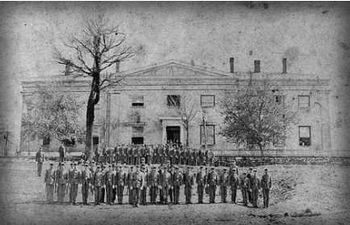
The reason the Dahlonega Mint is the most “mysterious” mint is because no photographs of the facility were taken when it was in operation between 1838 and 1861, despite the new technology making it possible. The only known photograph of the building was taken in 1878, shortly before the location burned down.
Located just north of modern-day Atlanta, the Dahlonega Mint produced over 6 million gold coins.
As you can imagine, gold nuggets and dust were not as practical for exchange. In the first years of the gold rush “down south,” the only way to have the gold refined into coins was to send it by wagon and riverboat to the U.S. Mint in Philadelphia.
This cumbersome journey led many in Georgia to lobby Congress to establish a minting facility in the area.
An intense debate on the nation’s money (gold-backed or paper) was raging at the time. However, the Dahlonega Mint had powerful allies in Senator John C. Calhoun of South Carolina and President Andrew Jackson. Calhoun’s bill specifically called for three new mints in the south – New Orleans (a busy port-city); Charlotte, North Carolina; and Dahlonega, Georgia.
The bill establishing these mints passed Congress and was signed into law by President Jackson in March 1835.
At the time, Dahlonega was hardly a town. Construction of the mint was slow, but it eventually opened for operations in 1838.
Due to a variety of reasons including the remote location and poor management, the Dahlonega Mint didn’t begin accepting gold for coinage until February 1838. Because the gold deposits had to be assayed and coined, the first coin didn’t roll out until April of that year. Only Half-Eagles were coined in the first year – production of Quarter-Eagles began the following year, with gold dollars added in 1849. Although the mint produced over 6 million coins in total, its production was low in comparison to the Philadelphia Mint.
When Abraham Lincoln, a ferocious defender of the Union, was elected in president in 1860, the Dahlonega Mint’s future became uncertain, especially once Georgia seceded from the Union in January 1861. At first, there was little change in the mint’s operation, but once Georgia was admitted into the Confederate States of America, the mint’s director offered to resign his post with U.S. Treasury and be re-appointed under the Confederacy.
Despite lobbying from the business community in Lumpkin County and the mint’s director, the Confederacy decided to close the facility. The heavy pressure from the local community did convince leaders to open an assay office at the site in August of that year however.
Although records from that time are very sketchy, the assay office operated until sometime in early 1864. But as the war drug on and the disastrous economic effects of armed conflict were felt all over the South, the office quit accepting deposits and was abandoned.
After the war ended in April 1865, many Georgians wanted to see the mint reopen, but their efforts were unsuccessful. The building and 10-acre plot was deeded to the North Georgia Agricultural College, which exists to this day as the University of North Georgia.
The college used the original mint building in its early years, but after it was destroyed by fire in late 1878, a new building was constructed on the foundation.
Although it closed, the legacy of the Dahlonega Mint lived on. In the 1950s, some of the gold from the area was turned into a thin foil-type material and donated to the state of Georgia for its Capitol building, which is one of Atlanta’s most recognized landmarks.
Interested in some more history of gold and silver?
Explore fascinating stories like this one about the Dahlonega Mint in our monthly blog series. Check back with us again in September as we travel back in time.

