
After gold hit a low under $1200 in late June, the metal seemed to be in recovery mode for the rest of the summer.
Through August, September and October, gold trended upward and tested important resistance levels of $1350 – $1360. At the end of October, gold once again broke above $1350.
The rally off late June’s bottom gave some gold bugs optimism. The hope was the bulls were in control, and that the correction from 2011’s peak of $1948 an ounce was finally over.
Yet the story for November doesn’t seem to be panning out for the gold bugs.
At the time this was written, gold has slid below $1290 and is off two percent for the week ending Friday, November 8. In the week before that, both gold and silver slid nearly three percent, which suggests the bear market isn’t quite over.
Strong Jobs Numbers and a Strengthening Dollar Tampering with Investor Sentiment?
Gold and silver enjoyed a strong rally following a surprise announcement from the Federal Reserve that it wasn’t going to begin tapering its stimulus as expected.
Dubbed “Quantitative Easing,” the various methods the central bank has used to resuscitate the economy have served as major support for gold since 2008-09. Any talk of winding these policies down has put pressure on gold this year.
Friday’s jobs report showed 204,000 jobs added to the economy in October — double Wall Street’s expectations despite a partial-shutdown in the first half of the month.
These stronger-than-expected numbers are leading some to speculate the Fed will begin tapering its stimulus/bond buying programs next month.
International Influence
Another factor putting downward pressure on gold comes from the European Central Bank, which announced a surprise cut in interest rates this week.
This decision led to moves out of the Euro and into U.S. Dollars. A strengthening dollar (against the Euro and other currencies) influences the gold price, as explained in an interview with Peter Hug, Director of Global Trading for Kitco.
Fed Tapering and an Improving Economy: Are the Bears Right?
Answers to this question vary more than the weather. It all depends on who you ask.
For example, Jeffrey Currie, head of commodities research at Goldman Sachs, was recently quoted saying gold was a “slam dunk sell” if the U.S. government ended the shutdown and raised the debt ceiling.
Currie forecasts “significant downside risks” for gold heading into 2014. Much of his gold pessimism is based on a slow and steady economic recovery.
Peter Schiff, head of Euro-Pacific Capital, strongly disagrees, saying not so fast.
ShadowStats: A Less Rosy Picture
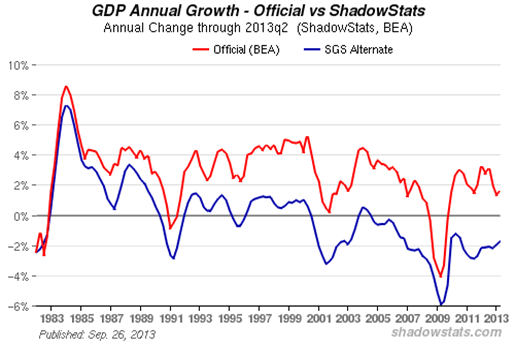
The veteran gold market investor, advisor and enthusiast cites alternative statistics that show a much gloomier picture of U.S. inflation and GDP.
While official methods for calculating inflation show a modest 1.2 percent increase in consumer prices, numbers from ShadowStats show a nine percent increase in consumer inflation.
ShadowStats uses the same methods the government used prior to the 1980s. If we look at GDP figures from the last few years, we find the economy never really got out of its recession — if we use ShadowStats’ numbers.
While the official government report showed a one to two percent rise in GDP in the second quarter of this year, ShadowStats reports a two percent decline in GDP in the same timeframe.
All the Gold in China
Schiff believes that, in the long term, gold will reclaim its record highs. He also cites other central banks who are accumulating gold and preparing for an eventual end to the dollar’s decades-long status as the world’s reserve currency.
Central banks around the world, especially China and India, have been stockpiling gold in recent years.
The U.S. Treasury is even on the record saying it would never sell the nation’s gold supply to satisfy debt obligations.
This robust physical demand, especially from China, is seen as gold’s biggest support right now.
According to Jeffrey Nichols of American Precious Metals Advisors, China’s “insatiable appetite” alone could move gold to new highs, even without a collapse in the dollar or some other doomsday scenario.
Another Low on the Horizon?
Jordan Roy-Byrne of The Daily Gold believes there is one more leg to this correction, and that we may see gold drop below its June low before recovering.
He explains that 2013’s market moves are quite similar to 1975-76, and that we experienced the first low in April, the second in June, and that we’re in the process of finding the final bottom now. He believes this low will be reached sometime in the next six weeks.
One thing seems clear: gold’s dip below $1300 fosters negative sentiment in the gold market.
In the short-term, gold may retest other support levels of $1250. If it falls below that, technical charts indicate $1200 is the next support level.
Price Dips: An Opportunity to Buy Gold Coins at a Low Cost
The truth is, we can’t tell you where gold will be in the short term.
Perhaps the correction that began in late 2011 is over and the last couple of weeks are just blips on the radar. Or, like Roy-Byrne says, maybe we have a final leg downward before a firm foundation is set and gold bulls come roaring back.
In the long-term, we think robust physical demand from China and central bank purchases are signs that gold will be strong.
Any move back to $1200 or even lower will represent a great buying opportunity for gold coins and other precious metals. If gold rallies much higher in 2014, 2015 and 2016, you won’t be able to purchase the quantity you can now.
What Do You Think?
Are we in the final phase of correction? Or will gold experience even more pressure going into 2014 and 2015 like Goldman Sachs believes?
When the bulls return, where do you think gold will be in one, two or five years?
Join the conversation. Leave a comment below or visit our Facebook and Twitter pages today.

