
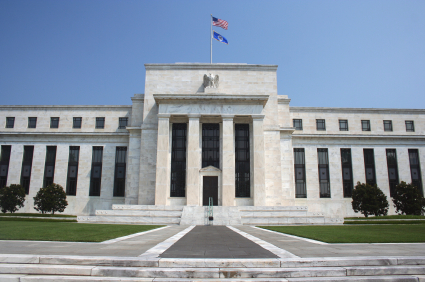
H.R. 459, better known as the Federal Reserve Transparency Act of 2012 (…or Audit the Fed), has passed the full House of Representatives by a vote of 327-98. Passage of the bill represents a crowning achievement in the career of Congressman Ron Paul, the bill’s author.
For decades as a congressman and 3-time presidential candidate, Paul has worked tirelessly to bring attention to the monetary policies of the U.S. Federal Reserve. After the crisis of 2008 and ensuing fears about inflation and economic decay, more and more Americans have become interested in this critical, yet sometimes boring issue.
Commenting on his bill and the monetary issue in general, Congressman Paul explains:
“The American public now senses that the Fed’s actions, especially since 2008, are enormously inflationary and will cause great harm to the American economy in the long run. They are beginning to understand what so many economists still don’t understand, which is that inflation is a monetary phenomenon, and rising prices are merely a symptom of that phenomenon. Prices eventually rise when the supply of US dollars (paper or electronic) grows faster than the available goods and services being chased by those dollars.”
In its current form, Paul’s Audit the Fed bill requires the Government Accountability Office, or GAO, to fully audit both the Fed Board of Governors as well as the 12 Fed branch banks around the country.
Many of the Fed’s operations are already audited but this bill would require all books and deliberations involving the central bank’s discount window and open-market operations be made public… the bill would also require audits of any agreements made with foreign government as well as interest-rate decisions.
But besides these “operational” pieces of the Fed, the bill also presumably incorporates an audit of the nation’s official gold reserves, which are primarily held at the New York Fed and at Fort Knox. Many feel the U.S. no longer holds the over 8000 tons of gold official figures suggest, and that it’s been sold, swapped, or leased over the years. An audit of these holdings will certainly put the controversy to rest.
Not everyone though is eager to see a full audit of the Fed take place.
Federal Reserve Chairman Ben Bernanke argues that any discussions regarding monetary policy should remain secret. During a hearing before the House Financial Services committee last week, Bernanke testified:
“It’s a mistake to eliminate the exemption for monetary policy and deliberations which would effectively, at least to some extent, create a political influence or a political dampening effect on the Federal Reserve’s policy decisions”
Democrat Barney Frank, co-chairman of the Financial Services committee and author of the most recent Wall Street reform bill, opposes the measure as well. The veteran lawmaker from Massachusetts believes the markets will see the bill as political interference. Along with Bernanke, Frank fears that investors will come to think Congress is politicizing what interest rates should be.
Responding to this critique, Congressman Paul says any materials relating to open-market operations will not be available to Congress until 6-months following the action.
The bill though enjoys some support from Democrats and broad support from Republicans in the House. Ohio Democrat Dennis Kucinich, a vocal Fed critic from the political left, explains that the Fed should not be permitted to “…operate in the dark without oversight by Congress and accountability to the people.”
Although the bill passed well above the 2/3 majority it required in the House, passage in the Senate is a whole other matter. There is a corresponding bill in the upper-chamber but it seems unlikely the Senate leadership will bring the full audit up for a vote.
In 2009-2010, a similar bill from Dr. Paul gained broad support from across the political spectrum. A scaled back, one-time audit of the Fed’s actions during the 2008 crisis, made it into the final Dodd-Frank financial reform package. Since that audit, the American public was able to learn which companies received funds from the Fed during the 2008 financial meltdown.
As you know, the threat of spiraling costs due to monetary expansion is on the mind of many Americans. It’s a primary reason motivating many to buy silver bullion and gold coins as well as emergency food storage.
According to Congressman Paul, auditing the Fed is the first step toward ending its unchecked power over the economy. No one doubts, whether pro- or anti-Fed, that the U.S. central bank wields tremendous power over the economy.

