Last week after all the votes had been counted and we learned of the new political landscape in America for the next two years, Federal Reserve Chairman Ben Bernanke quietly announced what many of us have been expecting for awhile – Quantitative Easing Part II.
Just what is quantitative easing?
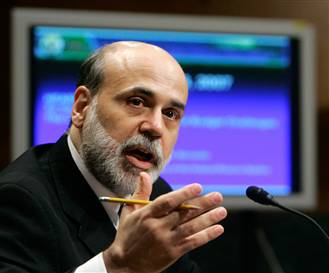
Federal Reserve Chairman Ben Bernanke
In its simplest form it means printing money but more specifically, quantitative easing increases the supply of money by increasing banks’ excess reserves.
Central banks generally accomplish this through buying government bonds in an effort to stabilize or increase their price, which in turn lowers long-term interest rates.
Another way to look at QE – it’s a dilution transaction akin to a company issuing more shares of stock. The big difference of course is companies take the funds raised through this dilution and reinvests them in their company to create more real value.
QE by governments and central banks on the other hand add no real value to the economy.
In our QE2 case, $900 billion will be diluted so the Fed can purchase U.S. Treasuries. The primary beneficiaries of this move are the U.S. Government and large financial institutions who sell that debt.
What effects will QE2 have on the value of the dollar?
Monetary inflation is defined as the growth in the money supply. This is slightly different than price inflation, which generally lags behind monetary inflation. If we take the final amount of QE2 ($900 billion) and compare it to the M2 money supply figure in the chart below, Bernanke’s plan will dilute the value of the dollar by 10%.
| Outstanding | $900B as Percent
of Market |
Diluted value of $900B
entering market |
|
| US GDP | $14,500.00 | 6% | $0.94 |
| US Federal Debt | $14,500.00 | 6% | $0.94 |
| M2 | $8,750.00 | 10% | $0.91 |
| M1 | $1,800.00 | 50% | $0.67 |
| Currency | $900.00 | 100% | $0.50 |
| Treasuries | $11,030.00 | 8% | $0.92 |
| Municipal | $2,670.00 | 34% | $0.75 |
| MBS | $8,860.00 | 10% | $0.91 |
| ABS | $2,600.00 | 35% | $0.74 |
| Money Market | $3,900.00 | 23% | $0.81 |
| Corp Bonds | $6,720.00 | 13% | $0.88 |
| Silver | $24.30 | 3703% | $0.03 |
| Gold | $2,475.00 | 36% | $0.73 |
If the QE funds happen to find their way into the gold market, we could see a 36% increase in the gold price since $900 billion represents 36% of the world’s gold supply. And considering $900 billion is 37 times larger than the world’s silver market, any move of QE funds into that market would generate an explosive rise in silver prices.
Therefore, we can safely assume that with this latest round of quantitative easing, inflation will rise by 10-20% on an annualized basis according to analysts. If you had a dollar on November 1st, it’s now worth $0.90 if measured against the M2 money supply figure.
The result of all of this will be real negative interest rates. However, this does present an opportunity to sell U.S. Treasuries and dollar based assets at a cost of near 0% while in turn taking the proceeds and investing in real assets like gold, silver and commodities.

