Cinco de Mayo is more than an opportunity to break out the margarita mix and throw a fiesta. The Mexican celebration that takes place on May 5 commemorates the Mexican army’s 1862 victory over French forces during the Franco-Mexican War.
This relatively minor celebration has morphed into a full-throated celebration of Mexican culture, with parades, mariachi music and fantastic food.
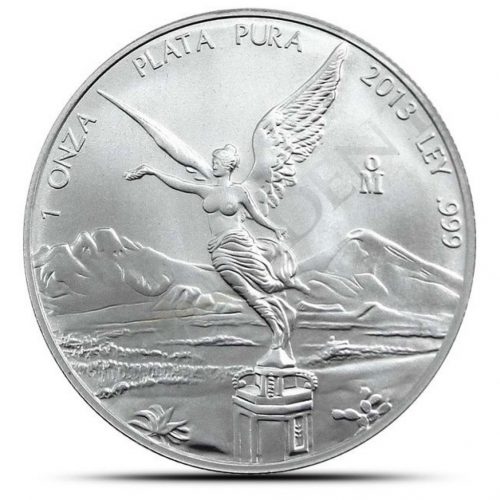
Mexico’s lush history is encapsulated in the nation’s silver bullion. In addition to a variety of vintage Mexican silver coins honoring heroes of the past, the popular Mexican Silver Libertad captures the many incarnations of México through the years.
Mexican Silver Libertad
The Libertad is the official bullion coin from La Casa de Moneda de México. Its design is based on a previous coin — the Centenario gold coin released in 1921 to commemorate 100 years of Mexican independence.
The obverse shows an angel of victory, the statue from a victory column erected to celebrate 100 years of Mexican independence. The column, Monumento a la Independencia, was completed in 1910 and still shines in downtown México City.
Behind the angel are a pair of volcanoes. Popocatepetl and Iztaccihuatl overlook the Valley of México and can be seen from México City. These volcanoes, in addition to providing a stunning natural backdrop, come with a tragic tale, passed on through oral histories from the native Nahuas.
Volcanic Love Story
As the story goes, Iztaccihuatl was a beautiful princess, beloved of her people and her family. Her name meant “white lady,” because she was very fair. After the girl grew up, she fell in love with a tribal leader named Popoca. The Emperor told Popoca that if he brought back the head of the enemy chief, he would allow Popoca to marry his daughter. Popoca went off to war.
After several months with no message from Popoca, an evil warrior sent a message saying Popoca had died in battle. When Izta heard this news, she was overcome with sadness and could not stop crying. She would not eat and refused to go out. A few days later, she died of a broken heart.
As the Emperor and Empress mourned their daughter and prepared for the funerals for both Izta and Popoca, Popoca and his warriors returned home. Shocked, the Emperor explained that Izta had died over grief for Popoca. In mourning, Popoca took Izta’s body, carrying her into the mountains. He arranged her body so she looked like she was sleeping and he kneeled to watch over her. Popoca died of grief, still there, looking over Izta.
The gods were so moved by this tragedy that they transformed Popoca and Izta into great volcanoes.
Popocatepetl, which means “smoking mountain,” often billows with clouds, showing that Popoca still watches over Izta.
Many National Seals
The reverse has nearly as much history. It shows the official coat of arms of México: an eagle perched on a cactus eats a snake. Other iterations of the coat of arms from 10 of Mexico’s states are in a ring around the national seal.
The coat of arms comes from the legend of Tenochtitlan. In this story, the Aztec city of Tenochtitlan (which later became México City) was founded on Lake Texcoco after a sign from the gods. The god of war, Huitzilopochtli, directed the Aztec people to settle there, selling the priests to look for a prickly pear cactus.
When the priests traveled to the lake, they found the eagle — the sign of the god — perched on the cactus, eating the snake. The priests declared they had found the spot, and built a temple to Huitzilopochtli there. Ultimately, the people transformed the boggy lake into a complex landscape and prospered.
To the Europeans who established modern México City, this story represented the fight between good and evil, the snake standing for evil and the eagle the conquering hero.
Modern México
With these many stories interwoven into the nation’s culture and silver bullion, the Mexican Libertad is among the world’s most popular investment pieces.
The Libertad contains 1 troy ounce of silver, though smaller and larger sizes are produced. It has a reeded edge and a diameter of 40.6 mm on the one-ounce Libertad.
Do you invest in Libertads? Why do you like them?
Tell us here or on Facebook, Twitter and Google+ today.




It’s one of my favorite coins, actually I love to collect all the Mexican silver coins. I’m waiting to see when the 2014 Libertads are being released. Every time I see the ‘El Angel de la Independencia’ I picture La Plaza en Mexico City.
What’s not to like? It’s a half naked girl with wings.