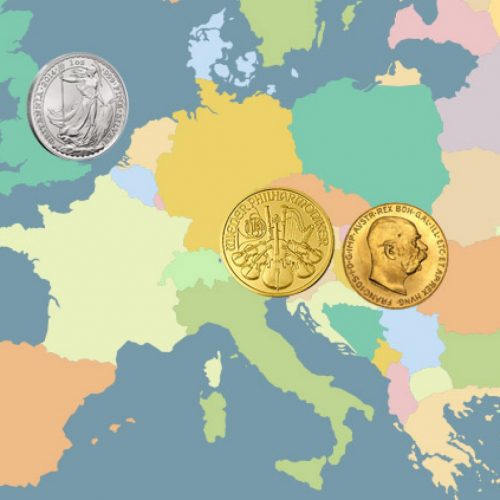
Our international coin tour now departs from the New World for a trip to the Old.
England
The 1 oz Silver Britannia is the most iconic bullion coin released by the Royal Mint. They were introduced in 1997, and were 95.8% pure silver. Since 2013, the purity has been .999 fine silver.
The reverse shows the goddess Britannia wearing a Roman-style helmet, gazing out to sea. She holds Poseidon’s trident and an olive branch. The obverse includes a portrait of Queen Elizabeth II.
England Highlights
- At the height of its power, the United Kingdom encompassed almost a quarter of the world’s land mass, making it the largest empire in history. Today, the United Kingdom is made up of England, Northern Ireland, Scotland, and Wales.
- Despite being an island 74 times smaller than the United States, England has 1.5 times more citizens than the state of California.
- The only place in the world where all six species of flamingo can be seen is at the Slimbridge Wildlife & Wetlands Trust in Gloucestershire.
- As you plan your visit, be sure to sample a wedge from Cheddar, England, where the cheese originated. Enjoy a traditional afternoon tea on your way to England’s first tourist attraction: Mother Shipton’s Cave in North Yorkshire. The owner fenced off the site in 1630 and charged admission to the “petrifying well.”
Austria
The hills may very well be alive with the sound of music in Austria, where even the bullion has a musical bent. The 1 oz Gold Austrian Philharmonic is legal tender and is eligible to be included in a precious metals IRA. It is composed of .999 fine gold.
The obverse celebrates the Great Organ of Musikverein, the Austrian Philharmonic’s concert hall in Vienna.
The reverse shows a Viennese horn, violins, a string bass, cello, harp, and bassoon, making this coin a true product of the symphony.
The same design is also available on the 1 oz Silver Austrian Philharmonic coin.
Austria Highlights
- The Austrian flag is one of the world’s oldest national flags, dating back to the Crusades in 1191.
- The tombs of composers Ludwig von Beethoven, Johannes Brahms, Christoph Willibald Gluck, Franz Schubert, Arnold Schoenberg, and Richard Strauss are all in Vienna’s Central Cemetery, along with 2.5 million others. There are more deceased in the cemetery than living people in the city.
- We can thank Austria for our clothing: the sewing machine was invented by Austrian Josef Madersperger.
- You may want to stay at Haslauer, the world’s oldest inn/restaurant still in operation. It was founded in Salzburg in 803! Enjoy a strudel and wiener schnitzel before enjoying some alpine skiing in the Alps, which make up 62% of the total land area.
Hungary
While this is not technically a modern coin, we felt our list was not complete without the Austria-Hungary Gold Corona, which were minted from 1892 to 1916 and circulated until relatively recently. Of course, Hungary is now part of the EU, but continues to use the Forint as their currency.
If that doesn’t deter you, the Gold Corona is composed of .196 troy ounces of gold. The obverse shows the portrait of Emperor Franz Joseph I, who reigned over much of Central Europe for 70 years.
The reverse shows the Austrian Coat of Arms across a crowned double-headed eagle.
Hungary Highlights
- The largest thermal water cave system (caves made up of hot springs) is in Hungary, as is the world’s second-largest thermal lake, and the largest national grasslands in Europe.
- Hungarian is said to be one of the most difficult languages in the world.
- Paprika is common on Hungarian dishes; the ground red pepper was a flavor innovation by chefs in the country.
- Pick up a Rubik’s Cube as a souvenir: it was invented by Hungarian Ernő Rubik. Soak in the largest medicinal bath in Europe at Szechenyi Medicinal Bath, and enjoy a glass of wine from this rich wine landscape.
Which coins from Europe are in your collection? Why do you like them?
Read more of this series: Coins of the World: Middle East
Leave a comment below or one our Facebook, Twitter and Google+ profiles.




Hungary may be part of the EU, but it has not yet adopted the Euro as currency. They still use the Forint, and have no current plans to adopt the Euro.
Thanks for setting us straight E.J., we’ll make that change right away!
I have an 1968 Serbia 1 para coin and several ancient roman coins cleaned from the age of emperor Constantine 2nd.
Fantastic! What a wonderful addition to your collection.