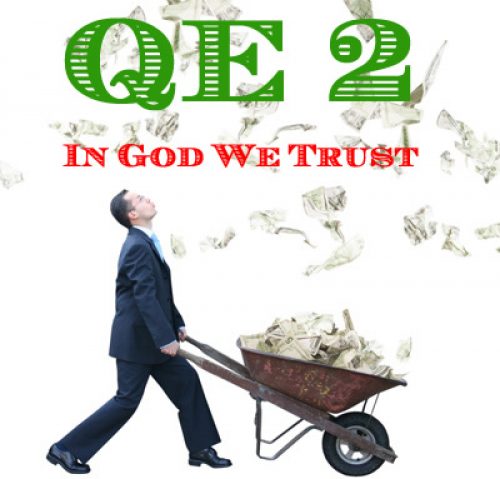
A few months ago just before Thanksgiving, we told you about a move by the Federal Reserve to buy U.S. Treasuries and increase the amount of excess reserves in banks.
Fed chairman Ben Bernanke said this move was needed to shore up an already shaky economic recovery.
But many have their doubts, including two chairmen of the Fed’s Richmond and Dallas branches who say the second round of quantitative easing (…the first being in 2009) is too much. They say since GDP growth is currently at 4%, QE-II is unnecessary and could pose serious inflation problems down the road.
One of Bernanke’s most vociferous critics though has slammed QE-II as not fulfilling any promises and creating the possibility of severe inflation.
Congressman Ron Paul (R-TX), the newly appointed chairman of the Domestic Monetary Policy and Technology subcommittee in the House, comments in an interview on Yahoo! “It [QEII] hasn’t done anything for Main Street; hasn’t done anything to give us real jobs; hasn’t done anything for people who are losing their houses.”
In his testimony (…at times heated) before the House Budget Committee, Bernanke says QE-II is working and inflation isn’t brewing.
Rep. Paul disagrees profoundly and cites the latest run in commodity and food prices, not to mention gold’s over 10-year climb.
The reason why Bernanke isn’t too concerned about inflation is that the government’s numbers on the matter, known as the Consumer Price Index (CPI), exclude food and energy prices Paul says. They also rely on what are called hedonic adjustments, which is a method that removes any price differential attributed to a change in a particular item’s quality.
“They rig that number” the congressman says. “[Bernanke] looks at government stats that are fudged to reassure him he doesn’t have to do anything.”
Others too, including Budget Committee Chairman Paul Ryan (R-WI), are harshly critical of the Fed’s policies at this time.
In fact, there’s been a growing move to have a full audit of the Federal Reserve. Congressman Paul’s bill to Audit the Fed received 320 co-sponsors in the last Congress. Although a full audit wasn’t passed, the Congress did mandate the Fed release information regarding its transactions during the financial crisis of 2008-09.
When the Fed released its numbers, several private firms and foreign governments received funds from the Fed including giants JP Morgan and Goldman Sachs but even McDonalds as well believe it or not.
Of course, any dilution of the money supply like QE-II is certainly to have a positive impact on gold and silver prices.
But what impact it ultimately has on inflation and unemployment remains to be seen. See interview below for more.




Leave a Reply