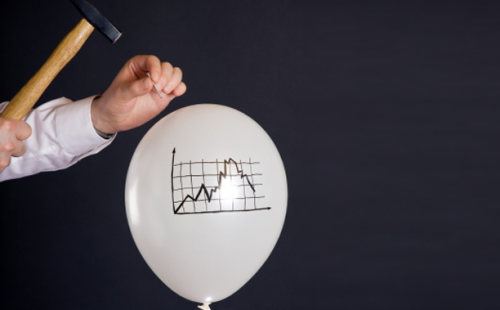
There are times when a certain asset or investment is all the rage. Then one day, bam, the bottom falls out…economists, analysts and investors refer to this as a bubble.
A bubble is precisely what occurred in the real estate market in the last decade. It also in fact occurred in the gold markets back in the late 70s and early 80s – prices for the asset rose tremendously for a few years but in the end, declined dramatically. Once the bubble ‘pops,’ it can take years to regain the losses if you purchased the asset at its peak price.
With gold prices up from $275 in 2001, many have speculated that gold is in a bubble due to “pop” at any time. The last three months in the gold market has certainly given that argument more ammo.
Data compiled by Dr. Constantin Gurdgiev and published on BusinessInsider.com paints a different picture though.
If you watch the precious metals markets like we do, you can certainly see gold has fallen from its near $2000 highs last summer. In the month of May, gold has dropped below the $1600 mark and is down about 6.4% in U.S. Dollars. Major stock indices on the other hand are off much more with the Dow down 1000 points (approx. 8%) since the last week of April.
In Euros, gold has done pretty well considering. While down just 2.15% in May, European stock markets have been in rapid decline following elections in Greece, France and elsewhere.
Demand for gold however hasn’t waned according to Dr. Gurdgiev’s data. While investment demand is down slightly, jewelry and technology has picked up the slack, up 9.24% and 3.8% respectively. Jewelry makers and industrial users of gold naturally tend to buy more when prices are down. Demand from Exchange Traded Funds, or ETFs, has dropped significantly but investor demand, while down 5.06% over the 4th quarter last year, is still amazingly resilient.
In fact, if you take average demand from the prior five years (2006-2011), the demand in the 1st quarter of this year is still higher than the average for the past 5 years according to the data.
Other correlation data like gold price-to-investment demand and gold price-to-jewelry demand also does not seem to indicate a bubble in gold. According to charts, demand for jewelry typically increases when gold is trending lower. Bullion demand on the other hand increases when gold is trending higher.
To get some interesting technical information on these relationships and more, check out Gurgiev’s data.
So what does all of this portend for the future?
Well we can’t tell exactly of course, but data like this is certainly encouraging to those of us who don’t think gold is in a bubble at all! So, where is it going from here?
As we discussed in our last market update post, events here and overseas have tremendous impacts on the price of gold. Continued troubles in Europe for example can put downward pressure on gold priced in dollars, in the short-term anyway. Recent election results coupled with high tensions may result in Greece exiting from the European Union.
If that occurs, gold priced in dollars may take a hit for a short bit as investors will seek short-term safety in the dollar. In fact, the dollar index is currently at its highest level in over 18 months.
Other analysts though say that another round of the infamous quantitative easing is on the horizon.
Chris Puplava over at Financial Sense has a compelling piece comparing the current environment to March 2009, which is the same time QE-I was announced. While the economy has shown some strength in the first few months of this year, the Fed hasn’t had the latitude to hit the ‘print’ button for a third time Puplava explains.
But falling commodity prices, falling inflation expectations and a weakening economy could change all of that.
Like gold, oil has dropped a pretty good bit in the last month or two for example. After peaking at just under $4 a gallon, gas has dropped almost $.60 a gallon in the last month.
When the three above mentioned conditions are in place, the Fed may indeed initiate a 3rd round of quantitative easing. Puplava speculates that renewed printing could be announced at the Fed’s June meeting.
If this occurs, gold prices will certainly go higher, perhaps even over $2000. That’s not a consensus though but rather a prediction by some analysts.
Either way, this may be the best buying opportunity for gold bullion we’ll see for a long time…
If gold were to see really dramatic increases in a short period of time, the asset could conceivably be considered in a “bubble.” But as the last 10+ years have shown – sometimes gold is up, sometimes it’s down.
Over the long-term though it’s definitely up – the same can’t be said for very many other assets.




Leave a Reply