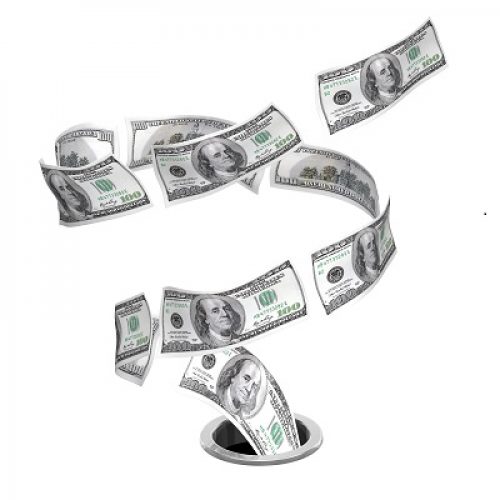
Inflation is another one of those alarming, yet distinctly vague terms you’ve heard thrown around a lot in the last few years. Concerns about “rising prices” and the value of the U.S. dollar after all is what drove many of us to invest in gold and silver coins in the first place.
Although “inflation” is commonly used to describe rising prices in the economy, the term actually means an increase in the money supply. Rising prices are simply a symptom of inflation.
Regardless of how it’s defined, all of us can certainly identify with today’s higher cost of living. Whether it’s gas, groceries, healthcare or housing, things cost more than they did 100, or even 50 years ago.
This handy tool, the U.S. Inflation Calculator, gives us a glimpse of how costs have increased. For example, the default example on the calculator shows that $20 in 1913 equals roughly $471 today.
Cumulatively speaking, that’s an astounding 2253 percent inflation rate. And that’s based on the official rate reported by the U.S. Government!!
If you’re thinking that is impossible, let’s narrow the time frame to 2000-2013 where we still see that $20 at the turn of the 21st century equals roughly $27.06 today. This represents an increase of more than 35 percent – just in the last 13 years!!
Of course, the figures you hear in the press are simply a reflection of how much prices have risen in the last year or so… But if we look over a longer period of time, it’s easy to see how much the value of the U.S. dollar has declined.
Also, the inflation rate is a general measure. As we discuss in our knowledge center piece explaining the Consumer Price Index, prices for some items could be rising rapidly while others are falling.
Take the latest government reports as an example. In May of this year, the inflation rate increased for the first time since February. Although the price of gas was stable, and the price of groceries actually retreated somewhat, the cost to rent or own a home increased.
According to the CPI report, the inflation rate for May 2013 stands at +1.4 percent over May 2012. This is up from April’s number of 1.1 percent…
This seems low – gas prices went up where I live, and a dozen eggs cost more too…
If you’re scratching your head thinking how in the world can the official inflation rate be that low, you have to remember that the U.S. Bureau of Labor Statistics (BLS) is using a different formula than it did in the past.
For example, if we calculate the current year-over-year inflation rate using the method from before 1980, we find that the inflation rate is somewhere between 9 and 10 percent. John Williams’ ShadowStats calculates these figures using prior methods.
You may be thinking that 9-10 percent is a more believable number, probably because it is.
In his most recent remarks, Fed chairman Bernanke explained how inflation was in fact low. As we can see from ShadowStats and a long-term view of the dollar, that isn’t exactly true. Monetary inflation, or expansion of the money supply, has been very high in the last few years. While the full effects of this haven’t been felt in terms of higher prices, many worry that all of the Fed’s stimulus will eventually result in much higher prices for everything from a movie ticket to a gallon of milk.
This continued expansion of the money supply – which in effect makes every other dollar out there worth less and less – is one of the central reasons for investing in gold coins and other precious metals.
What are your thoughts?
Will price inflation continue its current course, decrease, or rise dramatically in the years ahead?
Do you buy precious metals as a hedge against this inflation?
Join the conversation – leave a comment below, or visit our Facebook or Twitter pages today for more.




Whoooooo Hoooooo!! Der’s gold in dem der hills!!!